
What If One AI Request Could Use Multiple Apps at Once?
Imagine telling an AI assistant:
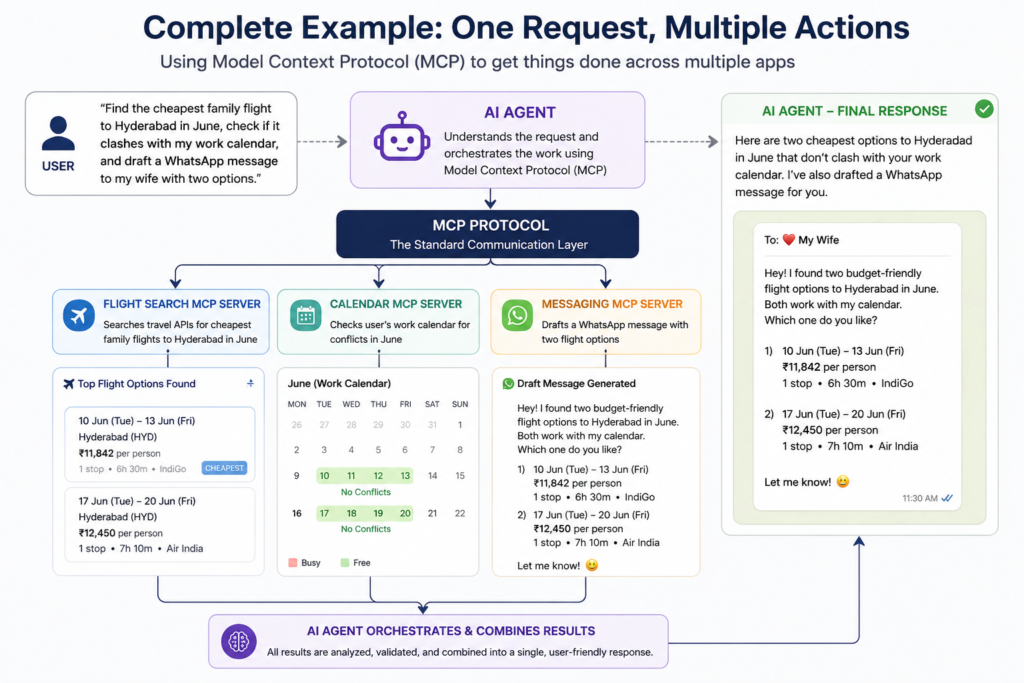
“Find the cheapest family flight to Hyderabad in June, check if it clashes with my work calendar, and draft a WhatsApp message to my wife with two options.”
And it actually does it.
Not just suggest flights.
But:
- Searches a travel tool
- Reads your calendar
- Checks schedule conflicts
- Drafts a message
- Saves the itinerary to your notes
All from one request.
No switching apps.
No copy-pasting.
No jumping between tabs.
How could that even work?
That idea is exactly what Model Context Protocol (MCP) is trying to make possible.
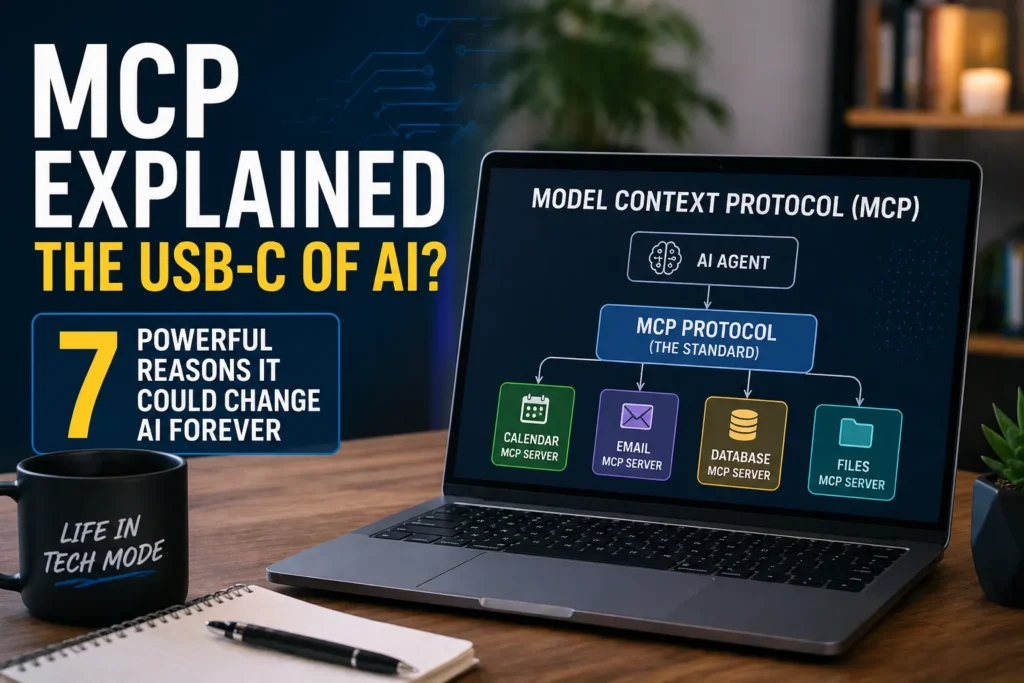
And that is why many people are calling it the USB-C of AI agents.
If you have been hearing about MCP and wondering whether it is just hype or something truly important, this guide explains it simply.
What Is Model Context Protocol (MCP)?
Model Context Protocol (MCP) is an open standard that allows AI models and AI agents to connect to tools, applications, and data sources using a consistent method.
Think of it as a universal connector for AI.
Without MCP:
AI → Custom integration → Calendar
AI → Custom integration → Email
AI → Custom integration → Database
With MCP:
AI → MCP Standard → Multiple Tools
Instead of every connection being custom-built, MCP aims to make those connections standardized.
That is a big shift.
1. MCP Could Make AI Much More Useful
Today many AI tools are mostly chat interfaces.
You ask.
They answer.
But what if AI could do more than answer?
What if it could act?
With MCP-style connectivity, AI agents may:
- Search systems
- Retrieve files
- Update records
- Trigger workflows
- Coordinate across apps
That moves AI from chatbot…
To assistant.
And potentially, to agent.
If you have been experimenting with local AI models, my guide on How to Run an Offline AI Assistant on Your Laptop and Phone with Gemma (insert your internal link here) shows how this evolution may reach personal devices too.
2. MCP Is Not Replacing APIs — It Works With Them
This is a major misconception.
MCP is not an alternative to APIs.
It does not replace APIs.
It sits above them.
Think of it this way:
| Technology | Purpose |
|---|---|
| API | Gives access to functions or data |
| MCP | Standardizes how AI uses APIs |
| AI Agent | Uses MCP to perform tasks |
APIs remain the plumbing.
MCP is the universal connector.
That is why the USB-C analogy makes sense.
For deeper technical context, review the official resources from Anthropic and the developer materials from OpenAI.
3. The “USB-C for AI” Analogy Is Actually Brilliant
Years ago, every device needed a different cable.
Messy.
Then USB-C unified things.
MCP aims to solve similar fragmentation in AI.
Why the analogy fits:
One Standard
A common way for AI to connect to tools.
Less Friction
Less custom integration work.
Faster Adoption
More tools can become AI-ready.
That is why developers are excited.
You can also explore open projects related to this on GitHub.
4. MCP Could Power the Next Wave of AI Agents
There is a major shift happening.
From chatbots…
To agents.
A chatbot tells you how to plan a trip.
An agent may eventually:
- Find flights
- Compare prices
- Check your calendar
- Draft your itinerary
That requires multiple tools.
That requires interoperability.
That is where Model Context Protocol matters.
If you are curious how other AI tools are moving toward connected assistants, see my article on Google Gemini Personal Intelligence Features (insert internal link here).
A Practical Enterprise Example
Imagine asking an AI:
“Check whether this disputed card transaction has a related case, pull customer history, and draft a response note.”
That could require access to:
- Case management system
- Customer database
- Knowledge repository
Multiple systems.
One task.
That is the type of workflow MCP could help support.
5. It Could Reduce Vendor Lock-In
This is an underrated benefit.
If internal tools become MCP-compatible, organizations may gain flexibility.
They may switch AI providers more easily.
For example:
Move from one model provider to another without rebuilding every integration.
That can reduce costs.
And improve long-term flexibility.
That matters to businesses.
6. MCP Could Help Developers Build Faster
Today developers often build:
- Custom connectors
- Wrappers
- Tool interfaces
- Integration logic
Again and again.
MCP could reduce repetitive work.
Potential benefits:
- Faster integrations
- Reusable connectors
- Easier agent development
- Less duplicated effort
That could accelerate innovation.
7. MCP Could Become Foundational Infrastructure
This may be the biggest reason to watch it.
Some believe MCP could become like:
- HTML for websites
- APIs for software
- USB-C for devices
A foundational layer.
That sounds ambitious.
But many major technologies looked small in the early days.
It is worth paying attention.
For another example of early technologies that can change how we work, you may like my article on Practical Uses of NotebookLM (insert internal link here).
Why This Matters Even If You Are Not Technical
You do not need to be a developer to care.
This could affect tools ordinary people use.
Personal Productivity
Imagine asking:
“Summarize all emails about my son’s school events and add dates to my family calendar.”
That could become easier.
Work Automation
AI assistants may help pull information across tools for reports.
Personal Finance
AI may help analyze subscriptions or spending by connecting across apps.
That is practical value.
Will MCP Replace Plugins?
No.
MCP may complement or simplify many plugin-style integrations.
Think of plugins as individual extensions.
Think of MCP as a broader standard.
They can coexist.
And in some cases, MCP may make plugin-like behavior more scalable.
Challenges MCP Still Must Solve
Every promising standard has challenges.
MCP has several.
Security
How much access should agents have?
Permissions
What actions require approval?
Trust
How do users verify what agents do?
Adoption
Will major platforms embrace one standard?
These questions matter.
And they will shape how fast MCP grows.
Companies Paying Attention
Interest is growing around:
- Anthropic
- OpenAI
- GitHub
That is usually how standards spread.
Developers first.
Platforms next.
Mainstream adoption later.
What You Can Try Today
Even if you do not use MCP directly, you can explore the broader AI agent trend.
Try:
- AI coding assistants
- Research agents
- Workflow automation tools
- Tools with local context features
And watch how AI moves from:
Answering questions…
To doing work.
That is the bigger story.
Final Thoughts
If you remember only one thing, remember this:
Model Context Protocol is not replacing APIs.
It is trying to create a universal way for AI agents to connect to tools.
That is why people call it:
The USB-C of AI.
And if that vision succeeds, future AI assistants may become much more capable than the chatbots we know today.
That is why MCP matters.
FAQ
What is Model Context Protocol?
Model Context Protocol is an open standard that helps AI models connect to tools and data sources in a consistent way.
Is MCP replacing APIs?
No. MCP works with APIs rather than replacing them.
Why is MCP called the USB-C of AI?
Because it aims to standardize how AI agents connect to tools, similar to how USB-C standardized device connections.
Suggested Links:
Internal Links
- https://www.lifeintechmode.com/offline-ai-assistant-gemma/
- https://www.lifeintechmode.com/gemini-free-personal-intelligence-gmail/